Lung cancer remains the leading cause of cancer-related deaths in the United States, but advances in early detection and treatment are improving the outlook for patients. Over the past two decades, five-year survival rates have nearly doubled, rising from 15% to 27% – progress driven in large part by clinical research. This Lung Cancer Awareness Month, the Alliance for Clinical Trials in Oncology is highlighting how its research is advancing earlier detection, improving treatments, and enhancing quality of life for survivors.
Despite progress, the need for continued progress remains significant. The American Cancer Society projects about 230,000 new lung cancer diagnoses this year, with a lifetime risk of 1 in 19. While smoking remains a major risk factor, the U.S. Centers for Disease Control and Prevention (CDC) reports that up to 20% of cases occur in people who have smoked fewer than 100 cigarettes in their lifetime.
Through seven active clinical trials focused on prevention, early detection, treatment, and survivorship, the Alliance is helping move promising research forward toward better outcomes for people with lung cancer. This work is made possible by the dedication of trial participants, clinicians, researchers, and patient representatives.
Trials for People with Lung Cancer
Alliance A081801: Integration of immunotherapy into adjuvant therapy for resected NSCLC: ALCHEMIST Chemo-IO (ACCIO)
Led by Jacob Sands, MD, of the Dana-Farber Cancer Institute, the phase III ALCHEMIST study looks at a new way to treat non-small cell lung cancer after surgery. Doctors want to see if adding an immune-boosting drug called pembrolizumab to regular chemotherapy will help participants live longer. While chemotherapy attacks cancer cells directly to stop them from growing, pembrolizumab helps the participant’s own immune system fight off the cancer. Researchers are testing whether using both treatments together gives patients with stage IIA, IIB, IIIA or IIIB non-small cell lung cancer the best chance of staying cancer-free.
Alliance A082101: Neoadjuvant immunotherapy in sarcomatoid mesothelioma
This phase II study, led by Aaron Mansfield, MD, of the Mayo Clinic, is testing whether immunotherapy before surgery can improve outcomes for people with stage I to IIA sarcomatoid mesothelioma. Researchers are evaluating a combination of two immunotherapy drugs, nivolumab and ipilimumab, to see if they can help the immune system recognize and fight cancer cells, shrink tumors, and make surgery more successful. The goal is to improve disease control and patient outcomes.
Alliance A082302: Evaluating adjuvant atezolizumab or atezolizumab and hyaluronidase-TQJS to prevent recurrence in stage I non-small cell lung cancer (NSCLC): A randomized phase III trial (AASI-NSCLC)
Led by Muhammad Furqan, MD, of the University of Oklahoma, this phase III trial is evaluating whether immunotherapy can reduce the risk of recurrence in people with stage I non-small cell lung cancer after surgery. While standard care typically involves monitoring patients with routine scans and checkups, the study tests whether starting atezolizumab, an immunotherapy drug that helps the immune system fight cancer, immediately after surgery can prevent the disease from returning. Read the news release.
Alliance A082402: Involved-station, intensity-modulated post-operative radiation therapy (I²-PORT) for resected non-small cell lung cancer with residual mediastinal adenopathy after neoadjuvant therapy (ypN2)
Led by study co-chairs David Kozono, MD, PhD, of Mass General Brigham Cancer Center, and Jeremy Brownstein, MD, of The Ohio State University, this phase II randomized trial is evaluating whether a highly targeted radiation approach called involved-station, intensity-modulated post-operative radiation therapy (I²-PORT) can reduce the risk of cancer returning in people with non-small cell lung cancer. The study focuses on patients who received chemotherapy and immunotherapy before surgery but still had cancer cells in their lymph nodes. Researchers are comparing standard post-surgical treatment alone with targeted radiation followed by standard care to determine whether treating high-risk areas while sparing nearby healthy tissue can improve survival and reduce side effects. Read the news release.
Research for Lung Cancer Survivors
Alliance A211901: Reaching rural cancer survivors who smoke using text-based cessation interventions
Devon Noonan, PhD, MPH, FNP-BC, of Duke University School of Nursing, leads Project Reach, a phase III trial evaluating a text-based smoking cessation program for cancer survivors in rural communities. Recognizing that smoking can affect cancer outcomes and long-term health, researchers aim to determine whether mobile-based support can provide an accessible, effective way to help survivors quit smoking and improve their overall health.
Research Focused on Prevention and Early Detection
Alliance A232301CD: An enhanced eHealth and chatbot-enabled delivery model for clinical genetic services in community AYA cancer patients
Angela Bradbury, MD, of the University of Pennsylvania Abramson Cancer Center leads the AYA Access Study exploring whether online genetic education and at-home genetic testing can make genetic risk information more accessible to adolescents and young adults (AYA) with a history of cancer. The study aims to overcome barriers to genetic services and help more young adults understand their inherited cancer risk. Read the news story.
Alliance A212102: Blinded reference set for multicancer early detection blood tests
Marie Wood, MD, of the University of Colorado School of Medicine, leads this study to collect and store blood and tissue samples from people with and without cancer to help evaluate and advance tests designed to detect multiple cancers earlier. Lung cancer is among the cancers included in this research, which aims to support the development of more effective early detection approaches.
Continuing Progress
This Lung Cancer Awareness Month, the Alliance recognizes the patients and survivors who take part in clinical trials, the families and others who support them, and the clinicians and researchers working to advancing cancer care.
Every trial builds our knowledge. Every participant helps move research forward. And every discovery brings us closer to a future with fewer lung cancer diagnoses, better treatment, and more people survivors.
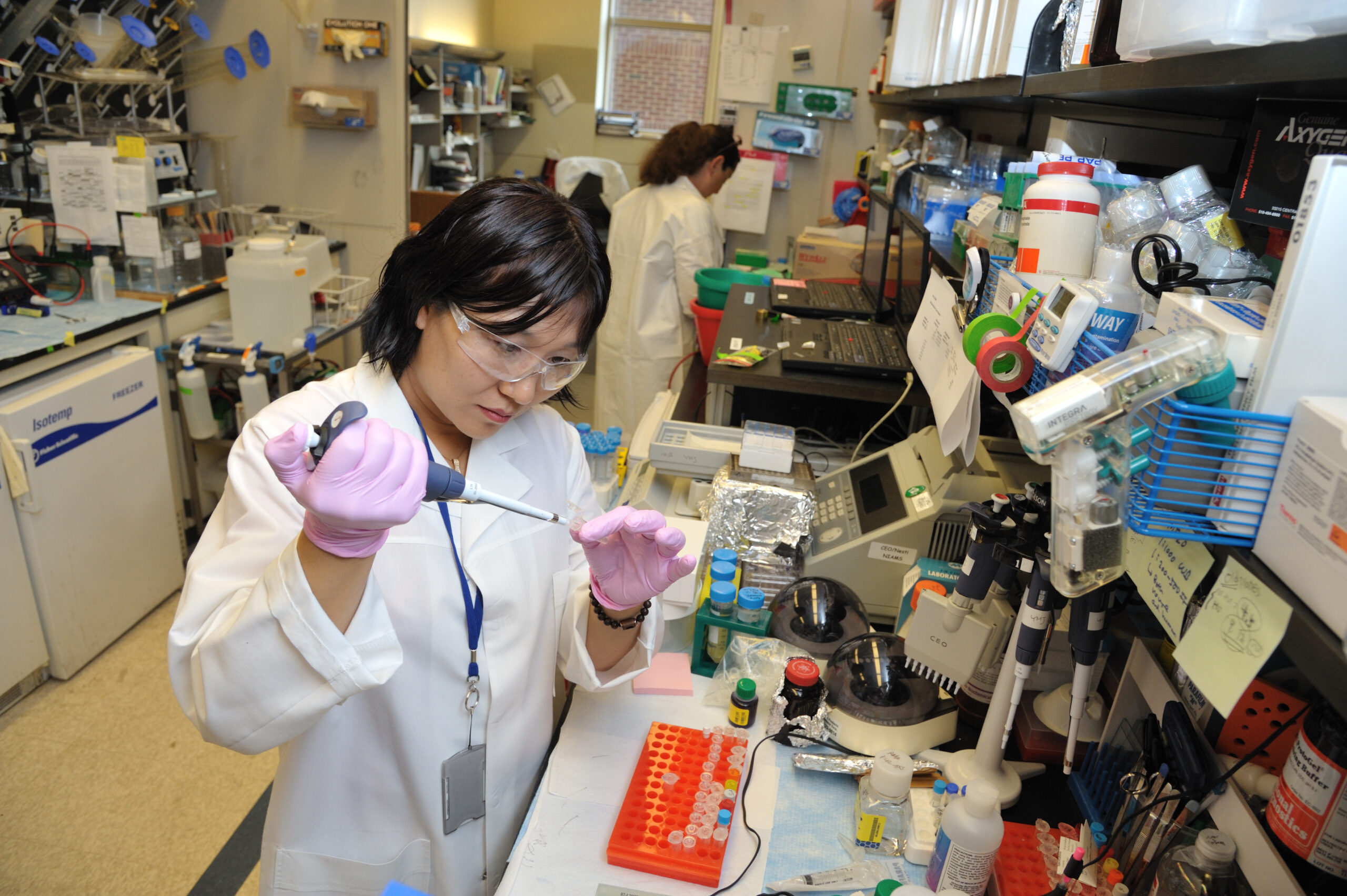
Photo credit: National Institute of Arthritis and Musculoskeletal and Skin Diseases, National Institutes of Health